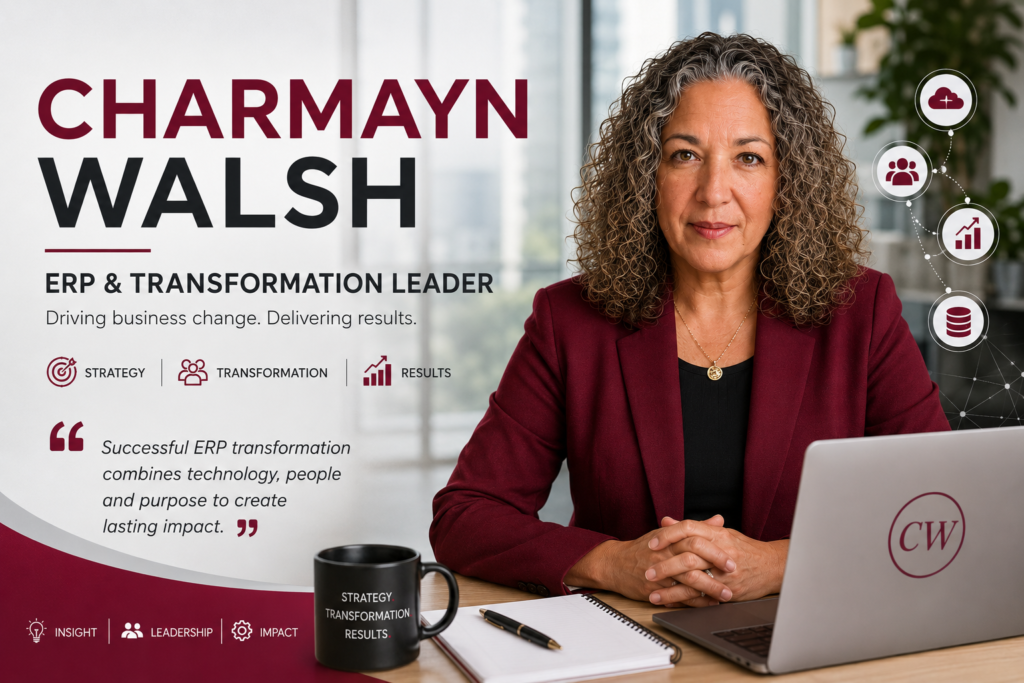
ERP transformation is changing rapidly. What was once primarily an IT project focused on replacing legacy systems has become a much broader business transformation involving people, processes, data, technology and leadership.
For professionals such as Charmayn Walsh, who has extensive experience in ERP and business transformation, the changing ERP landscape presents both exciting opportunities and important challenges. Organisations today are not simply looking for new software. They want technology that can help them become more agile, improve decision-making and create sustainable business value.
As artificial intelligence, cloud computing and data analytics continue to develop, the future of ERP transformation is becoming increasingly intelligent and connected.
What Is ERP Transformation?
ERP transformation is more than implementing an enterprise resource planning system. It involves rethinking how an organisation operates and how technology can support its strategic goals.
Traditional ERP implementations often concentrated on configuring software, migrating data and training employees. Modern ERP transformation takes a wider view.
Businesses are now asking how their ERP environment can help them:
- Improve financial and operational visibility
- Automate repetitive processes
- Reduce inefficiencies
- Improve data quality
- Connect different business functions
- Support better decision-making
- Scale operations more effectively
- Create a better experience for employees and customers
This shift means ERP transformation is increasingly becoming a board-level business priority rather than simply an IT responsibility.
How AI Is Changing ERP Transformation
Artificial intelligence is one of the biggest developments shaping enterprise technology.
AI can help organisations analyse large amounts of information, identify patterns and automate repetitive activities. Within ERP environments, this could support areas such as financial reporting, forecasting, procurement, supply chain management and invoice processing.
However, successful AI adoption is not simply about adding an AI feature to an ERP platform.
Businesses need to understand where AI can genuinely improve their operations.
This is where transformation leadership becomes important. The approach associated with experienced professionals such as Charmayn Walsh highlights the importance of connecting technology decisions with business objectives.
AI can provide powerful capabilities, but organisations still need clear processes, reliable data and people who understand how to use these tools effectively.
Cloud ERP and the Move Away from Legacy Systems
Cloud technology is another major factor influencing ERP transformation.
Many organisations have relied on legacy ERP environments for years. While these systems may still support critical operations, they can sometimes become expensive to maintain and difficult to adapt to changing business requirements.
Cloud ERP offers a different approach.
Businesses can benefit from greater flexibility, scalability and access to continuously evolving technology. Cloud environments can also make it easier for organisations to support distributed teams and integrate new digital services.
But moving to the cloud should not be viewed as a simple technology upgrade.
A successful cloud ERP strategy requires businesses to examine their existing processes and determine what should be retained, improved or redesigned.
Simply transferring inefficient processes into a new system does not create meaningful transformation.
Data: The Foundation of Successful ERP
One of the most important elements of ERP transformation is often overlooked: data.
ERP systems depend on accurate and reliable information. Financial records, customer information, supplier data, inventory and operational information all need to work together.
Poor-quality data can lead to inaccurate reporting, inefficient processes and poor business decisions.
Data migration therefore needs to be treated as a strategic part of the transformation programme.
Before moving information into a new ERP environment, organisations should ask:
- Is the existing data accurate?
- Which information is still required?
- Are there duplicate or outdated records?
- Who is responsible for data quality?
- How will data be governed after implementation?
With AI becoming increasingly important, the quality of data matters even more. Intelligent systems can only provide useful insights when the information they rely on is trustworthy.
People Are at the Heart of ERP Transformation
Technology alone cannot deliver successful transformation.
Employees are the people who use ERP systems every day, and their understanding and acceptance of the change can significantly influence the outcome.
This makes change management a critical component of ERP transformation.
Employees should understand why the organisation is changing, what the transformation means for their roles and how the new processes will improve the way they work.
Training should not be treated as something that happens only shortly before launch. Organisations should provide communication, engagement and support throughout the transformation journey.
The human side of ERP is particularly important because even the most advanced technology can fail to deliver value if people do not embrace it.
Why Governance Matters
Large ERP programmes can involve multiple departments, technology teams, external partners and senior stakeholders.
Without effective governance, projects can experience scope changes, unclear responsibilities, rising costs and delays.
Strong ERP governance provides a framework for:
- Clear accountability
- Decision-making
- Risk management
- Programme reporting
- Scope control
- Stakeholder alignment
- Business and technology coordination
Good governance does not have to create unnecessary bureaucracy. Instead, it should help organisations make better decisions while keeping transformation aligned with strategic goals.
This is an area where experienced ERP transformation leadership can make a significant difference.
What Businesses Should Consider Before Starting ERP Transformation
Every organisation has different requirements, but several principles can help create a stronger foundation for transformation.
Start With Business Objectives
Before selecting technology, organisations should understand what they want to achieve.
Is the objective to improve efficiency, reduce costs, improve reporting, support growth or create better customer experiences?
The technology should support those objectives.
Understand Existing Processes
Businesses should examine how work is currently performed before deciding what needs to change.
This can reveal unnecessary processes, bottlenecks and opportunities for automation.
Prioritise Data Quality
Data should be cleaned, structured and governed before it becomes part of the new environment.
Invest in People
Employees need communication, training and support throughout the transformation.
Establish Strong Governance
Clear leadership and accountability can help keep complex ERP programmes focused and controlled.
The Future of ERP Transformation
The future of ERP transformation will be shaped by the combination of AI, cloud technology, automation and data.
ERP platforms are becoming more intelligent, while businesses are expecting technology to provide faster insights and greater flexibility.
However, the organisations that achieve the greatest value will not necessarily be those that adopt every new technology first.
Instead, success will depend on how effectively businesses connect technology with their people, processes and strategic objectives.
The role of transformation leaders will therefore continue to evolve. Professionals such as Charmayn Walsh demonstrate why experience across ERP, programme delivery, governance and business change remains valuable in an increasingly complex technology environment.
Final Thoughts
ERP transformation is no longer just about implementing a new enterprise system. It is about creating a business that can adapt, operate efficiently and make better decisions in a rapidly changing digital environment.
AI can provide intelligence. Cloud can provide flexibility. Data can provide insight.
But leadership, people and clear business objectives bring these elements together.
As organisations prepare for the next generation of ERP, the most important question may not be which technology should we implement?
Instead, businesses should ask:
“What do we want our organisation to become, and how can ERP transformation help us get there?”
That is where technology becomes more than a system—it becomes a driver of meaningful and sustainable business change.